Showing posts with label Information Needs of Children. Show all posts

Wednesday, September 19, 2012

Information Needs of Children - "Beginning Readers"

First off, a bit of an introduction: What some libraries refer to as "Easy Readers", our library system refers to as "Beginning Readers". These books are aimed at approximately K-2 grades when a child is first learning to read on their own. They contain anywhere from one word on a page, to the very easiest of "chapter books". And now...onto the books!

Spring Surprises by Anna Hays

Spring Surprises is a beginning reader that describes the transition from winter to spring: the animals come out of hibernation, the snow melts, new flowers begin to bloom, and a family is finally able to enjoy typical outside spring activities again. 

The book engages new readers with a majority of illustrations, short, rhyming sentences, in a large font size. It also succeeds in presenting "first facts" about the passage between two seasons.

This book is appropriate for ages 4-6.


Ducks Go Vroom by Jane Kohuth

Ducks Go Vroom is intended for very early readers. It is mostly 2-4 word sentences that describe the actions and noises of a duck family as they go visit a family of geese. 

The book engages new readers with a majority of illustrations, and short, rhyming sentences in a large font size.

This book is appropriate for ages 3-5.
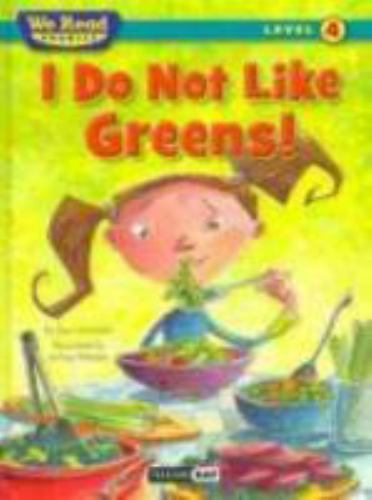


I Do Not Like Greens! by Paul Orshoski

I Do Not Like Greens! is a story about a typical child who does not like, nor want to eat her vegetables. She would rather have meat and sweets, but once her dog eats piles of meat and sweets and she sees her dog get sick, she realizes vegetables aren’t that bad after all. 

This book works to engage new readers like most beginning readers do – the text rhymes and is arranged in short sentences with a larger font size. Also, most children can relate to not wanting to eat vegetables or foods that seem “strange” to them, and will enjoy reading about a child their age. This book begins and ends with games you can play before, while, or after you read, and what kid doesn't like games?!
This book is appropriate for ages 4-6.


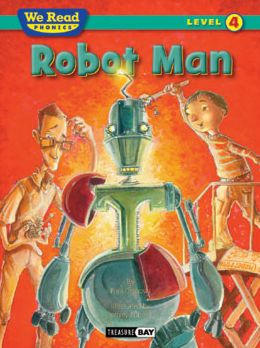
Robot Man by Paul Orshoski

Robot Man is a story of a boy and his dad who are tired of doing chores, so they order a build-your-own-robot to assemble and then do the chores for them. Everything is fine at first, but eventually something on Robot Man breaks and he starts doing everything wrong. The result? Mom makes them send back the robot and do the work themselves. 

This book is published by the same company as I Do Not Like Greens! and shares the same qualities to engage new readers: rhyming text in short sentences with a larger font size, about a child their age, and also begins and ends with games you can play.

This book is appropriate for ages 4-6.


Mac and Cheese by Sarah Weeks


Mac and Cheese is essentially a re-telling of The Odd Couple, but using cats instead of people. Mac and Cheese are best friends, but Cheese doesn’t like to do anything that Mac does. In the end, though, when Mac is in trouble, Cheese does everything he hates to do in order to help Mac. 

This book also has short sentences with rhyming text in a larger print. It is about cats (and we know that children typically enjoy reading about animals), and teaches children valuable lessons such as: it is okay to have friends who are different than you; and you should do things your friends like, even if they’re not your favorite things to do.

This book is appropriate for ages 5-7.

Thursday, September 13, 2012

Information Needs of Children - Non-Fiction


How You Were Born by Joanna Cole

How You Were Born is an informational book for young children about how babies are formed. While the author does mention that the egg and sperm must connect to form a baby, there is no mention of how the sperm and egg come together. Most of the book is focused on the different developments occurring at the different months during gestation. Cole also includes a note to parents on how to best use the book.

This book is likely to be “popular” with young children who are first beginning to wonder where babies come from. As an informational book it is obviously intended to be used to teach children about the subject (sex ed).

This book may be appropriate for ages 5-7.


I See the Rhythm by Toyomi Igus

I See the Rhythm is a beautiful book that combines art, poetry, and African American history. Each two-page spread has a painting, a poem, a portion of a timeline, and a paragraph explaining the meaning of the poem, certain words in the poem, or the art depicted. Each of the poems are about a different era of African American music.


This book is likely to appeal to younger African American audiences. Teachers and parents may find this book useful to teach about poems, art, or the history of African Americans or music.


This book is appropriate for ages 6-8.


The Edible Pyramid by Loreen Leedy

The Edible Pyramid is a book that attempts to explain the very basics of the food pyramid to young children. The educational information is told somewhat in story form, through the grand opening of a restaurant in a city of animals. The waiter teaches all of his new customers about the different sections of the food pyramid, what foods would be in each section, and how much of each type of food healthy "animals" should eat daily. Lastly, the waiter explains why there are steps on the food pyramid (to encourage exercise daily).

This book is likely to be “popular” with young children who like to eat! Parents and teachers would be able to use this book to teach children the names of food, and how to eat healthy. There is an endless array of food and exercise activities and crafts that could go along with this teaching.

This book is appropriate for ages 3-5.


Down the Colorado by Deborah Ray

Down the Colorado is a biography of John Wesley Powell. The story tells of his whole life, from his childhood as a PK (preacher’s kid), to growing up to serve in the Civil War (where he lost his arm). The majority of the book focuses on what Powell was most well-known for – his exploration of the Colorado River. Throughout the book there are small portions of text that appear to be short selections from Powell’s journal. At the end of the book there is a map of the expedition and a timeline listing the different locations they were at on certain dates, as well as a timeline of Powell’s life.

This book would likely be most popular with children who enjoy reading historical fiction. While this book is considered non-fiction, it does present facts in an adventure-fashion, rather than textbook-fashion. Teachers and parents may find this book useful in teaching about John Wesley Powell, biographies, the Colorado River, whitewater rafting, or the Grand Canyon.

This book is appropriate for ages 8-10.

Wednesday, September 12, 2012

Information Needs of Children - Mercy Watson to the Rescue by Kate DiCamillo


Mercy Watson to the Rescue is the story of Mercy the pig (who randomly loves buttered toast) and her family. Mr. and Mrs. Watson are in bed one evening on the second floor of their home when the bed begins to fall through the floor! Mercy sees to it that the fire department is brought in to save her family. 

This book is a great transitional reader because it is almost disguised as a beginning reader, only longer. The font is still larger than most chapter books, and the sentences are relatively short. Each chapter – while not episodic – is structured in such a way that nothing is “lost” if a child wants to put down the book if they need a break from reading and continue at a later time. It engages new readers in many ways: illustrations are on every other page, if not every page, and are very bright with very detailed expressions; the story is very humorous and is about an animal, which children statistically tend to enjoy; most children will be able to relate to Mercy, especially the fact that she is afraid of the dark; the book ends with an excerpt from the next book in the series to encourage the reader to continue following Mercy’s adventures.

This book is appropriate for ages 6-8.

Thursday, September 6, 2012

Information Needs of Children - Caldecotts (Part 2)

Owly and Wormy: Friends All Aflutter by Andy Runton


Owly and Wormy: Friends All Aflutter! is a wordless picture book about Owly and his friend Wormy and their attempts to grow a garden to attract beautiful butterflies. While they are unable to attract any butterflies, their yummy plants do attract caterpillars. In the meantime, Owly and Wormy decide to make friends with the caterpillars instead, so you can imagine how distraught they are when the caterpillars disappear! 

The book is predictable, though for children’s learning purposes that can actually be a good thing. Children will learn about the life cycle of a butterfly amongst many other things. As with all wordless books, this book is a great opportunity for children to improve their storytelling and/or writing abilities (as they essentially have to make up the story themselves). However, the author/illustrator also provides many clues through speech bubbles and signs as a guide for children in case they can’t tell what’s going on without a little help. This encourages children to use their imagination to figure out what the pictures in the speech bubble are trying to “say” (i.e. the four-leaf-clover = “good luck!”).

This book is appropriate for ages 4-6.


First the Egg by Laura Seeger

First the Egg attempts to pair the age-old question “What came first - the chicken or the egg?” with child-friendly illustrations. “First the egg, then the chicken” is followed by other animals or objects that evolve from something else (i.e. “First the tadpole, then the frog”), only to wind up again at “First the chicken, then the egg”, leaving the mystery still unsolved. 

While the original concept of “the chicken or the egg?” may be a bit too complex for children to handle, the other “First, then”’s in the book can be very educational. Children will also be able to see a step-by-step process or growth on each page - using the frog as an example again, on the first page, the tadpole is a tadpole; the next page shows a tadpole growing legs, followed by the page with a full frog on it.

This book is appropriate for ages 3-5.


So You Want to be President by Judith St. George

So You Want to be President? gives a brief and very kid-friendly idea of what it is like to be a president (the president has lots of “homework”, but doesn't have to eat vegetables), and some of the most random qualities, hobbies, etc. that you could ever want to know about them. 

In the back of the book there is a timeline of the 43 presidencies (pre-Obama, as that is when this edition was revised and published), the years of their terms, and a very brief summary of what they were most well-known for. This book meets the information needs of children if they need to know any historic trivia fact about our presidents from their size, to their pets, to their musical abilities.

This book may be appropriate for ages 7-9.

Wednesday, September 5, 2012

Information Needs of Children - Caldecotts (Part 1)


Fairly Fairy Tales by Esmé Codell

Fairly Fairy Tales is a story about a child who does not want to go to bed. In the beginning the child says “yes” to a goodnight kiss and "yes" to a glass of water, but “NOOOOO!” when asked if it is bedtime. After the mother quizzes the child on different traits of classic fairy tales ("yes" there are sticks, straw, and bricks in the story of the Three Little Pigs, but “NOOOOO!” there is not a disco ball in Cinderella), the child realizes that “well, maybe” those things could have happened in the stories, finally leading her to the conclusion that “well, maybe” it is time for bed after all. 

This book represents a concept so universal that EVERY child should be able to relate to – sometimes they’re just not ready for bed. Another way this book meets the information needs of children is by helping children to memorize and recount parts of famous stories they are likely to have heard before. Children are also encouraged to use their imagination and to realize that anything is possible. This aspect then leads to the potential of improving storytelling and/or writing abilities because it gives readers a chance to almost “re-write” classic fairy tales with a new spin. 

This book is appropriate for ages 3-5.


A Couple of Boys Have the Best Week Ever by Marla Frazee

A Couple of Boys have the Best Week Ever is about - go figure - a couple of boys (James and Eamon) who spend a week at Eamon’s grandparents house so they can go to a Nature Summer [Day] Camp. However, it appears they have more fun at Bill and Pam’s (Eamon's grandparents) house than they do at summer camp. 

I have mixed feelings about this book for children. On one hand, it can be a great book for kids who may be nervous about going away to a summer camp (or anywhere away from home) for an entire week. The book may help to build children’s humor and even understand sarcasm. In the end it shows how kids can do nice things for their grandparents, and that everyone has different hobbies. Sometimes boys just need to be silly boys. However, throughout the illustrations the boys (typical as this may be, it's not exactly healthy) play video games that result in them getting so angry they look like they might explode. It also appears that almost everything depicted in the speech bubbles is actually meant for an adult reader, especially when the boys learn “new vocabulary words” (“@#%&!”) as grandpa tries to drive around bad drivers.

This book may be appropriate for ages 7-9.


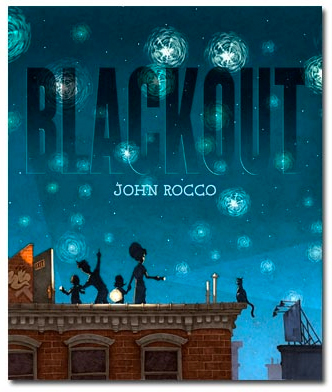
Blackout by John Rocco


Blackout is a very realistic picture book that takes place in a city on a hot summer day. The family in the story is too busy to spend time with each other - dad is cooking, mom is working on the computer, and sister is gossiping on the phone, when all little brother wants is someone to play a board game with. When the power goes out throughout the entire city, though, everyone is forced into a simpler life that they actually seem to enjoy. Suddenly there is time for board games, neighbors spend time with each other in the street, and ice cream is given away for free (since it’s going to melt anyway). 

Blackout is illustrated very similarly to Maurice Sendak’s The Night Kitchen, teaching children how to follow a story from picture block to picture block, rather than page to page. The story also has a great message behind it, applicable especially to families today : it’s not a horrible thing to put away technology and go outside for a while, hold hands, and take time for one another.

This book is appropriate for ages 4-6.

Monday, September 3, 2012

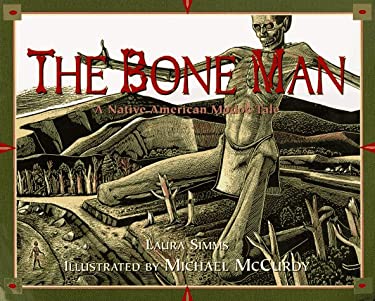
Information Needs of Children - The Bone Man by Laura Simms


The Bone Man is a book written by Laura Simms and illustrated by Michael McCurdy. It is a tale that originated with the Modoc (Native American) tribe. The book is about a Modoc boy named Nulwee whose grandmother would tell him the legend of Kokolimalayas: the Bone Man. On the day that Nulwee was born, Kokolimalayas "drank the river dry and devoured all the people". When Nulwee is old enough to be a warrior, it will be his job to kill Kokolimalayas and bring back the water and the people; until then, Kokolimalayas lies sleeping, hidden in the distance. One day as Nulwee is away picking berries, his singing wakes the Bone Man. The Bone Man makes Nulwee bring food to him to grow strong again, until he finally threatens to kill Nulwee and his grandmother. It is at this time that Nulwee realizes he must become a warrior and kill the Bone Man before the Bone Man can kill them.

This book would likely be most popular with children who like scary stories. Teachers could use this book in school as part of a Halloween or skeleton theme. They could also use this book to teach children about the Modoc Indians or folktales.

This book may be appropriate for ages 8-10.

Thursday, August 30, 2012

Information Needs of Children - The Dreamer by Pam Ryan


The Dreamer is the story of Neftali Reyes, the Chilean boy who grows up to become author Pablo Neruda. Neftali grows up with his stepmother, older brother, younger sister, and overbearing father who is abusive in almost every way. Neftali is painfully shy and has difficulty talking to anyone outside his family. He is a very smart boy, though, and loves exploring new things and expressing himself through words. He grows up rather frail, and his father tries most everything (including almost drowning him in the ocean) to get him to "man up" and become a doctor. However, as he grows up, Neftali decides he would rather become a poet and write on behalf of the Mapuche – a peoples being exiled from their own land by the government – and in doing so, changes his name to Pablo Neruda to protect himself.

I cannot see this book being popular with children, as there is really no adventure or mystery. However, I do feel the book is something teachers could use as a lesson about Chilean culture, or fighting for a cause in which one believes.

This book may be appropriate for ages 9-11.

Information Needs of Children

As I briefly mentioned, this past semester I took my first class towards my LIS degree - it was the Information Needs of Children. Almost every week we read a handful of books and wrote a journal entry where we summarized the books and commented on whether or not they covered the information needs of a certain age from birth to about age 12. In case any of my readers are fellow library students who might find this helpful, or parents who are concerned about more than just enjoyable books that are "fun" to read, I decided to turn this into a mini-series where I will share my findings with you. 

These posts will be composed only of a brief summary, a response to a writing prompt which generally deals with the book's relevancy to the information needs we learned about in my class, and a personal recommended age range for the reader. It will not contain the publisher's summary of the book, subjective comments as to why I did or did not care for the book, Amazon's suggested age range for the reader, or a crown rating like my other reviews.

All of these books are considered "good" books in at least one way: books selected for this class could not be ones randomly pulled off a shelf. All books had to be either approved by the teacher or an an approved book list, reviewed by a reputable journal, or an award-winning book.
Copyright http://www.ysprincess.blogspot.com/ 2009-2012.


Disclaimer: The views expressed in the blog are the sole views of the writer (me), and do not reflect the views and/or policies of PBCLS or any other organization.

OnePlusYou Quizzes and Widgets